How to Analyze Customer Reviews with AI: A Practical Guide
Analyzing customer reviews with AI is no longer an option reserved for large companies. Today, any business that receives opinions on Google, Tripadvisor, Facebook, or marketplaces can turn that volume of comments into faster, more accurate, and more profitable decisions. Instead of reading every review manually, artificial intelligence can detect patterns, identify friction points, and prioritize improvements with real impact on online reputation.
Many companies accumulate dozens or hundreds of reviews every month. However, few turn that feedback into a competitive advantage. That is the problem. Having opinions is not enough. What matters is knowing what customers are saying, why they are saying it, and which actions should come first.
Why analyzing customer reviews with AI changes your strategy
When a business reviews comments manually, it often walks away with a general impression: “customers like the service,” “there are complaints about wait times,” or “the product is well rated.” The problem is that this reading is usually incomplete, slow, and subjective.
AI improves that process because it allows you to:
- Classify large volumes of reviews in very little time
- Detect positive, neutral, or negative sentiment
- Identify recurring topics
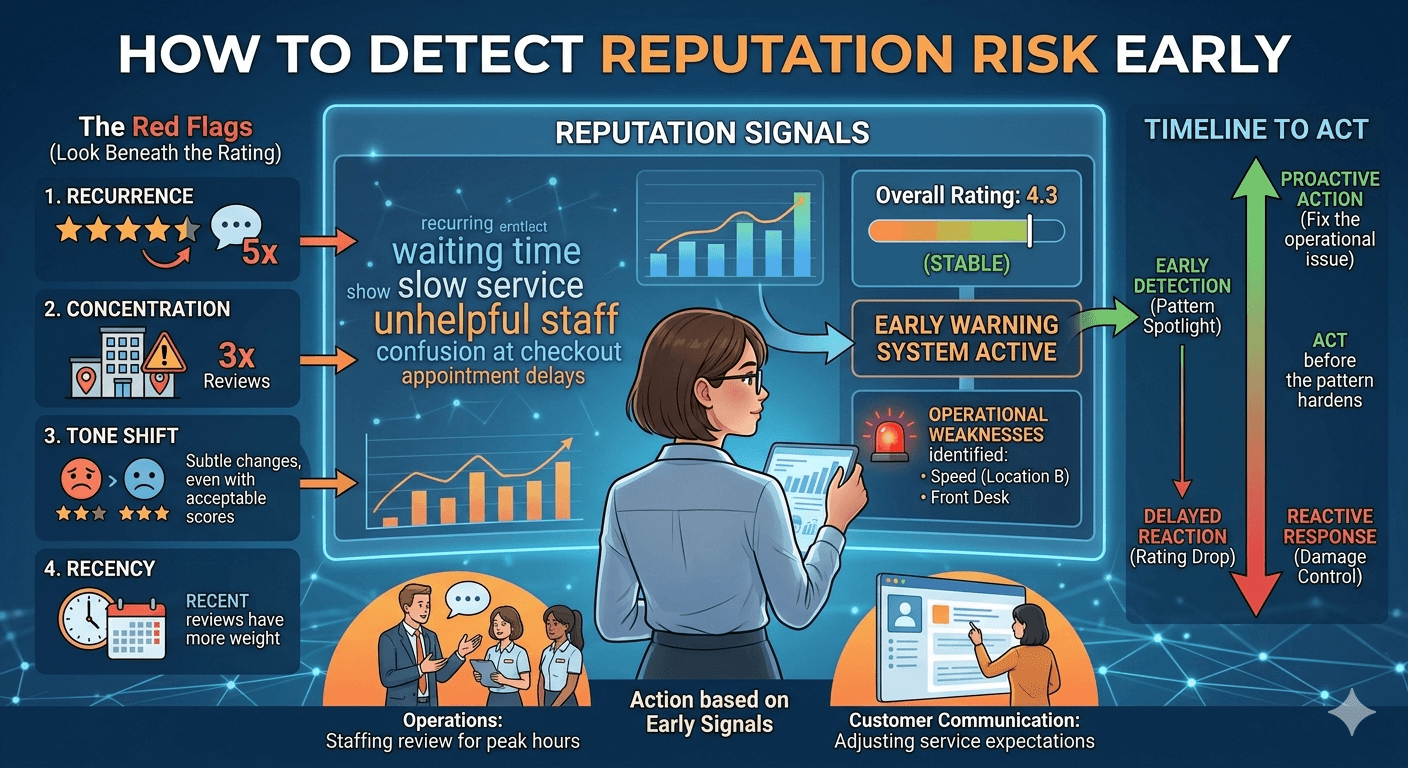
- Flag urgency or reputation risks
- Find strengths worth amplifying in marketing
In other words, analyzing customer reviews with AI turns scattered opinions into useful information for leadership, operations, marketing, and customer support.
This methodology also helps avoid decisions based on intuition. Instead of acting on feelings, the business can rely on clearer data. That is why more and more brands use review analysis to prioritize actions that improve customer experience, average rating, and trust.
What data you can get by analyzing customer reviews with AI
One of the biggest mistakes is to think a review only serves to show stars. In reality, behind every comment there are highly valuable signals.
Sentiment and overall tone
AI can interpret whether a review expresses satisfaction, frustration, disappointment, or enthusiasm. This helps you understand the overall state of the customer experience.
Recurring topics
It can also group mentions into categories such as:
- Customer service
- Wait time
- Price
- Product quality
- Cleanliness
- Delivery
- Ease of use
Thanks to this, the business stops looking at isolated opinions and starts seeing trends.
Improvement priorities
Not every issue has the same impact. That is why AI can help you distinguish between:
- Frequent but minor issues
- Rare but severe issues
- Strengths that generate many positive reviews
- Weak points that damage reputation
This approach allows you to allocate resources more intelligently and speed up continuous improvement.
How to analyze customer reviews with AI step by step
Implementing this process does not have to be complex. In fact, it can be broken down into a very clear sequence.
1. Gather all your review sources
The first step is to centralize comments coming from different platforms. The more sources you include, the more complete your customer view will be.
The most common ones are:
- Google Maps
- Tripadvisor
- Yelp
- App Store
- Google Play
If the business has several locations, it is worth separating information by site. That way, you can compare performance across stores or franchises.
2. Clean and organize the information
Next, the data needs to be organized. It is important to remove duplicates, review dates, and distinguish between recent and older reviews. That way, the analysis will reflect the current situation rather than an outdated perception.
3. Apply semantic and sentiment analysis
This is where artificial intelligence comes in. The system processes the text to detect emotions, keywords, themes, and context. It does not simply count mentions. It also interprets which issues keep appearing and how they affect customer perception.
4. Detect patterns and opportunities
Once the reviews have been processed, the strategic part begins. For example:
- If many customers praise staff friendliness, that is a strength
- If complaints about wait times appear frequently, there is an operational issue
- If one location receives worse comments than another, it is worth investigating why
- If praise repeatedly centers on a specific product, it can be used as a sales argument
5. Turn findings into actions
This step makes the difference. The analysis should not stay in a nice-looking report. It must translate into concrete decisions, such as:
- Strengthening team training
- Adjusting internal processes
- Improving response times
- Changing marketing messages
- Replying to reviews with a clearer strategy
Common mistakes when analyzing reviews without a clear methodology
Although many companies review customer opinions, they do not always do it well. These are some frequent mistakes:
- Reading only negative reviews
- Not reviewing the context of each comment
- Making decisions based on isolated cases
- Not measuring change over time
- Ignoring patterns across different locations
- Not sharing insights with the team
That is why analyzing customer reviews with AI offers an important advantage: it reduces human bias and enables a more structured view.
It also helps detect signals that are easy to miss at a glance. That point is critical when review volume grows and the business needs speed without losing depth.
Real benefits of analyzing customer reviews with AI
When this system is applied correctly, the benefits appear across several areas of the business.
Better online reputation
By detecting issues earlier, you can fix them faster. That influences overall rating and the public perception of the brand.
Better customer experience
AI helps you understand what users value most and what creates friction. As a result, improvements are more relevant and visible.
More objective decisions
Teams stop debating perceptions and start working with data. This speeds up meetings, priorities, and follow-through.
More commercial opportunities
Positive reviews are gold too. They help uncover differentiators, strengthen brand messaging, and build more credible social proof.
Tools and best practices to start today
You do not need to wait months to get started. You can build a solid foundation right now with these recommendations:
- Define which platforms you are going to analyze
- Review trends by month and by location
- Classify comments by topic
- Measure strengths and weaknesses
- Establish a response protocol
- Repeat the analysis on a regular basis
It is also worth relying on specialized resources about reputation and customer experience. You can find more content in the Analytee blog: https://app.analytee.com/blogs
As a reliable external reference, Google explains the importance of managing your business presence and customer opinions in its Business Profile help center: https://support.google.com/business/
When it makes sense to use a specialized platform
If you receive only a few reviews per month, you may be able to start with simple analysis. But once volume grows, several needs appear:
- Consolidate all sources in one place
- Compare multiple locations
- Detect emerging topics
- Get clear reports for leadership
- Prioritize actions by impact
In that scenario, a specialized platform provides speed, consistency, and analytical depth. That becomes especially useful in sectors such as hospitality, retail, healthcare clinics, franchises, or local services.
Conclusion: turn reviews into decisions
Reviews contain one of the most valuable forms of feedback for any business. The challenge is not getting comments, but interpreting them correctly and acting in time. Analyzing customer reviews with AI lets you move beyond manual reading and into a more strategic, measurable, and results-oriented form of management.
If your company wants to turn opinions into concrete improvements in reputation, experience, and growth, Analytee can help you detect patterns, prioritize actions, and turn the voice of the customer into a competitive advantage. Discover how to do it from the platform and start making decisions based on real data.
Suggested image:
Review analysis dashboard showing sentiment, detected topics, and reputation alerts.
Suggested ALT text for image:
"dashboard to analyze customer reviews with AI and detect patterns"
FAQ about analyzing customer reviews with AI
What does it mean to analyze customer reviews with AI?
It means using artificial intelligence to process customer opinions, detect sentiment, identify recurring topics, and extract useful conclusions to improve the business.
What advantages does it have over manual analysis?
It saves time, reduces bias, detects patterns that are hard to see at a glance, and helps prioritize improvements more accurately.
Is it useful for businesses with multiple locations?
Yes. It is especially useful for comparing branches, detecting differences across locations, and finding good practices that can be replicated.
Can reviews from multiple platforms be analyzed?
Yes. Ideally, you should bring together comments from Google, Tripadvisor, Facebook, marketplaces, and any other relevant sources to get a complete picture.
How often should reviews be reviewed?
It depends on volume, but the recommended approach is continuous monitoring and at least a monthly review of trends.
Convierte reseñas en decisiones con review analytics
Si este artículo encaja con tu caso, revisa cómo Analytee estructura sentimiento, temas y prioridades de mejora a escala.
Explorar review analytics